



Global Health and Surgery
Summary
- The Lancet Commission on Global Surgery estimated in 2015 that 5 billion of the world's 7 billion people do not have access to surgery [1].
- That is the fact the discipline exists to address. One-third of the total global disease burden is now surgical, the majority being injury and cancer, and in 2015 the World Health Organization declared surgery to be part of public health at the World Health Assembly [1].
- This page covers what global surgery means, surgery as a cost-effective intervention, the four dimensions of access, the workforce targets, and task-shifting.
Definition
Global health is the health of populations in the global context; global surgery is surgery with an understanding of public health [1]. Surgeons understand the needs of their individual patients; public health adds an understanding of the surgical operations needed by the population, and global surgery aims to provide equitable and improved surgical care across the world [1].
Task-shifting is the practice, where there is a workforce shortage with a high surgical burden of disease, of moving appropriate tasks to less specialised health workers [1].
The global surgery ecosystem in Schwartz's account
Schwartz frames global surgery as an ecosystem, accessibility, affordability and innovation resting on energy, transportation and communication technology, bioengineering, sterile processing, supply chain, waste management, anaesthesia, nursing, radiology, pathology and laboratory services, business, public policy and culture, whose aim is equitable, accessible, affordable surgery for every human being; reliable electricity is the commonest limiting factor since monitoring, lighting, cautery, suction, warming, refrigeration and imaging all depend on it and most devices are not designed for unstable grids [2]. Five forces reshape priorities: the epidemiological transition of disease, mobile populations, ubiquitous information, a revolution for equity and human rights, and recognition of surgery's cost-effectiveness; surgery should be viewed as an investment rather than a cost, the Copenhagen Consensus of 2012 (four Nobel laureates) ranked surgical capacity the eighth most cost-effective investment against the world's problems, road traffic injury alone costing over $500 billion a year, and in 2015 the World Bank's DCP3 and World Health Assembly resolution 68.15 recognised surgery in public health for the first time [2].
Pathophysiology
The common misconception is about who a global surgeon is. Global surgeons are not system-specific surgeons but are specialised in providing the surgical needs of their communities: a practising surgeon is a retailer for the individual patient, whereas a global surgeon is the wholesaler of the surgical needs of the population [1].
This means all surgeons working in non-tertiary hospitals who perform life-saving and essential surgery, guided by the prevalent burden of surgical disease, are global surgeons [1].
It is a misconception that a global surgeon is primarily a high-income country surgeon helping low- and middle-income country surgeons periodically or through surgical missions [1]. High-income-country and subspecialist surgeons can mitigate only a very small part of the vast unmet need in LMICs; global surgery focuses on improving surgical health systems in parts of the world with a high surgical burden, through the local surgeons in those communities [1].
Clinical features
The consequence of poor access is presentation at a later stage. Patients with acute surgical needs in LMICs do not reach hospital, or reach it too late, in advanced stages of cancer, with already-infected open fractures, with a perforated bowel, or with burn contractures [1].
Unmet need is greatest in eastern, western and central sub-Saharan Africa and South Asia, regions where young mothers die of physiological conditions such as pregnancy for want of a caesarean section [1].
Etiology
Surgery was previously excluded from public health priorities on cost grounds. Surgical and anaesthesia care were perceived as too expensive and too complex to be a priority in resource-poor settings; the fact that early surgery saves lives and boosts the economy encouraged health planners to place surgery in the essential group of services in national health strategy [1].
That reappraisal followed an epidemiological transition: with the decline in communicable disease, one-third of total disease burden is now surgical [1]. Since the 2015 World Health Assembly declaration, scaling up surgical and anaesthesia care has become a worldwide movement under the umbrella term of global surgery [1].
Surgery becomes more cost-effective when it is not delivered as isolated interventions, but as a group of interventions within a platform of clinical care such as a district hospital [1]. The Disease Control Priorities group of the World Bank has identified the surgical procedures that address the substantial needs of populations [1].
Workforce and the burden of surgical disease in Schwartz's figures
- Africa carries 24% of the global disease burden with 3% of health workers and under 1% of financial resources; primary care physicians, nurses, midwives and advanced care practitioners deliver much basic surgery and anaesthesia in LMICs through "task sharing", Mozambique's tecnicos de cirurgia and assistant medical officers are primary surgical providers in some regions, with debate over quality, supervision and professional development, while migration drains poor countries: over 23% of US physicians trained abroad in 2004, 64% of them from low-income countries, and sub-Saharan emigration to the US is rising despite the WHO's 2010 Global Code of Practice [2].
- The world's 7 billion will reach 9 billion by 2050 with 2 billion over 60 (55% of them now in Asia) and over-65s overtaking under-5s just before 2020, while sub-Saharan Africa's baby boom will take it from 960 million to 4 billion by 2100; the 2010 Global Burden of Disease Study (291 causes, 21 regions, 187 countries, measured in DALYs) showed a shift from communicable, maternal, neonatal and nutritional to non-communicable causes, the surgical share of global disease rose from the 2006 estimate of 11% to the Lancet Commission's 30% (about 18% by other studies), and SOSAS surveys in Sierra Leone, Rwanda and Nepal found surgically treatable conditions in 11.2% of people with 25.6% of deaths avoidable, extrapolated to 288.2 million people in the 48 low-income countries and 5.6 million preventable deaths a year [2].
- Cancer: LMICs' share of new cases rose from 15% in 1970 to 58% in 2008 and will reach 70% by 2030, cancer has been the second cause of death worldwide since 2013, 20% of global surgery is cancer-related, nearly two-thirds of 7.6 million cancer deaths occur in LMICs, mortality-to-incidence ratios for breast, cervical and testicular cancer rise as income falls (breast cancer case fatality 59% in East Africa vs 19% in the US), and the Haiti earthquake exposed a hidden burden of late-stage tumours [2].
- Trauma kills 5.8 million a year, 90% in LMICs, 32% more than malaria, tuberculosis and HIV combined (10% of deaths), men dying twice as often except in burns; road traffic kills over 1.25 million (3% of LMIC GDP, 50 million injured, the leading killer of 15–29-year-olds, 49% pedestrians, cyclists and motorcyclists), seriously injured LMIC patients die twice as often as in HICs and more often prehospital, and deaths plateaued from 2007 to 2013 despite motorisation, suggesting the Decade of Action for Road Safety 2011–2020 is working; burns kill 265,000 a year (95% in LMICs, most never presenting), predominantly women and children at domestic stoves, South-East Asia has 27% of burn deaths, 70% of them women, African children triple the global rate, with telemedicine (Utah's Project ECHO tele-education in eight states and 21 countries; TeleBurn's 400 video consultations a year to 80 sites) extending specialist care [2].
Diagnosis
Access is assessed through four lenses: timeliness, capacity, safety and affordability [1]. The probability of access is the joint probability of all four, failure of any one means no access [1].
- Geographical access is the ability of a patient to reach a surgical facility within 2 hours, the crucial time for life-threatening haemorrhage [1].
- Capacity means the facility has the required infrastructure and workforce and is able to perform safe surgery [1].
- Affordability is the final barrier, when a patient cannot afford the surgery offered [1].
Although barriers appear most pronounced in LMICs, there are also disadvantaged and vulnerable populations in high-income countries [1].
Thresholds and severity
The numbers that define the field [1]:
| Metric | Figure |
|---|---|
| People without access to surgery | 5 billion of 7 billion |
| People in LMICs without access | 9 out of 10 |
| Additional operations needed each year | 143 million |
| Procedures performed worldwide each year | 313 million |
| Share occurring in the poorest countries | 6%, where over a third of the world's population lives |
| Target operative volume by 2030 | 5,000 procedures per 100,000 population |
The spread between countries is enormous: Ethiopia performs about 150 operations per 100,000 population, Hungary about 23,000 [1]. But more than 5,000 operations and further expenditure do not bring commensurate health benefits [1], which is why 5,000 is the target rather than a floor to keep climbing from.
Low operative volumes are associated with high case-fatality rates from common, treatable surgical conditions, injuries, early cancer and burns [1].
The workforce target has a defined benchmark and a defined plateau. A surgeon, anaesthetist and obstetrician at the district hospital are considered essential staffing, and in many LMICs the SAO density is under 5 per 100,000 population [1].
As the SAO number rises there is a dramatic improvement in key indicators such as the maternal mortality ratio, but the benefits plateau beyond 20 SAOs per 100,000 population [1].
By 2030 all LMICs are committed to scaling up to at least 20 SAO providers per 100,000 population, and reaching that benchmark in all countries requires 1.27 million providers to be trained by 2030 [1].
Where the workforce is short and the surgical burden high, task-shifting moves appropriate tasks to less specialised health workers [1].
The Lancet Commission on Global Surgery reference is Meara JG, Leather AJM, Hagander L et al., Global surgery 2030: evidence and solutions for achieving health, welfare, and economic development [1].
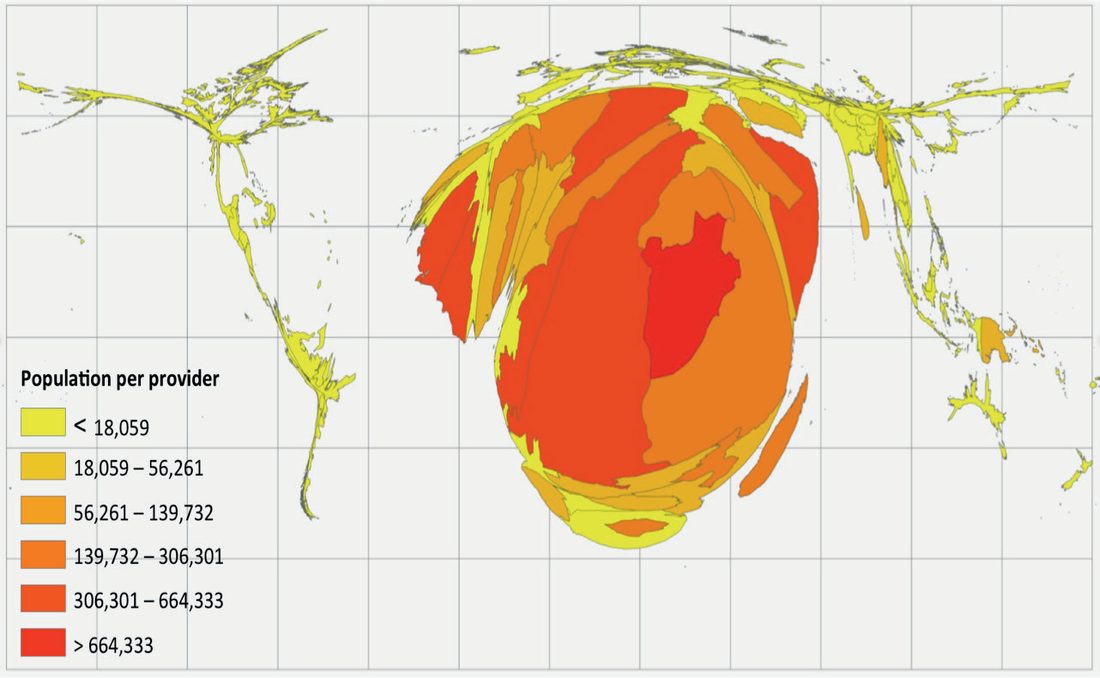
Essential surgery and cost-effectiveness in Schwartz's account
- DCP3 defines essential surgical conditions as primarily treated by surgery, of large burden and treatable cost-effectively and feasibly worldwide, listing 44 procedures for first-level (district) hospitals, obstetric (haemorrhage, obstructed labour, eclampsia, cord prolapse, ectopic, post-abortion sepsis), trauma (fractures, dislocations, soft tissue injury, pneumo/haemothorax, ruptured spleen), acute emergencies (strangulated hernia, obstruction, perforation, appendicitis, liver abscess, wound infection, osteomyelitis) and non-acute conditions (hernia, breast cancer, hydrocele, urethral stricture, prostatic hypertrophy, cataract), and estimates they would avert 1.5 million deaths a year (6.7% of avertable LMIC deaths) for $43 million of additional annual spending; the Lancet Commission on Global Surgery (110 nations) finds 5 billion people lack safe affordable surgical and anaesthetic care, 143 million more operations are needed where only 6% of the world's procedures occur, 33 million face catastrophic expenditure yearly, LMICs will lose $12.3 trillion in productivity by 2030 ($20.7 trillion by value-of-lost-output modelling), scaling the workforce to 20 surgical, anaesthetic and obstetric providers per 100,000 would cost $420 billion, and the district hospital must deliver three "bellwether" procedures (laparotomy, caesarean or hysterectomy, and open fracture treatment) as proof of full essential capability, with surgery "available, accessible, safe, timely and affordable" and publicly financed early on the road to universal coverage [2].
- Priority is set where public health burden is high, the procedure highly successful and promotion cost-effective and feasible, across four domains, trauma, obstetric emergencies, acute surgical emergencies and quality-of-life conditions (cataract, otitis media, clubfoot, hernia), and surgery prevents as well as treats: polypectomy, lumpectomy for DCIS, cervical excision, actinic keratosis and leukoplakia resection are primary prevention, birth attendance prevents fistula and haemorrhage, circumcision reduces HIV transmission, and Learmonth's 1949 lecture "The Contributions of Surgery to Preventive Medicine" was long neglected [2].
- The DALY (World Bank, 1990) sums years of life lost and years lived with disability; $100 per DALY averted is "highly cost-effective" in low-income countries, district surgical care matches or beats measles vaccination and antiretrovirals, caesarean delivery costs a median $304 per DALY and is highly cost-effective in 48 of 49 under-served countries with a benefit–cost ratio over 1 in 46, hernia repair costs $78.18 per DALY in Ecuador and $12.88 in Ghana, and sterilised mosquito netting is 3700 times cheaper than polypropylene mesh in India [2].
- Utilisation fails at three phases, deciding to seek care (socioeconomic and cultural: lost wages, travel, "willingness to pay", Mongolians refusing Tuesday surgery as bad luck), reaching a facility (geography, mitigated by triage protocols and telemedicine) and receiving adequate treatment (quality), and value equals quality plus service divided by cost [2].
Treatment and Management
Essential surgery is delivered through surgical healthcare delivery platforms rather than as isolated procedures, the district hospital being the model [1].
Building capacity is a training problem before it is a service problem, which is why the 2030 commitment is expressed as providers trained rather than operations performed [1].
Institutions, programmes and models in Schwartz's account
- Charitable platforms are temporary (short-term trips such as the World Surgical Foundation; self-contained mobile platforms such as Mercy Ships and Cinterandes, with little outcome data and higher complication rates for complex cases, though 9 years of training trips converted Mongolia from open to laparoscopic cholecystectomy) or specialty hospitals (Addis Ababa Fistula Hospital, Aravind Eye Hospital, PAACS mission hospitals); missions alone are not a sustainable answer to workforce shortage [2].
- The UN (51 signatories in 1945, 193 members now) set eight Millennium Development Goals in 2000 (lifting nearly a billion from extreme poverty) and 17 Sustainable Development Goals with 169 targets in 2015, SDG 3 adding a one-third cut in non-communicable deaths, halving road deaths by 2020 and workforce retention, with funding shared rather than HIC-dependent; the WHO (constitution 1948; smallpox eradicated from a 1958 Soviet proposal to the last Somali case in 1977) declared primary care the key to "health for all" at Alma Ata in 1978 without surgery, added basic surgery to primary care in 2008, and in 2015 passed WHA 68.15 unanimously (194 states) proclaiming surgery and anaesthesia crucial to primary care with nine member-state and ten Director-General actions; its Global Initiative for Emergency and Essential Surgical Care (2005; over 2100 members in 140 countries; IMEESC toolkit and the manual Surgical Care at the District Hospital) found no trained surgeons or anaesthetists at 44 Mongolian first-referral hospitals with electricity in 66% and running water in 45%, and a 2004–2010 programme in 14 of 21 provinces raised emergency rooms by 57.1%, emergency kits by 59.1% and case recording by 73.6% while national morbidity and mortality fell; the Violence and Injury Prevention programme runs the Helmet initiative and the Essential Trauma Care Project (2001, with the International Association for Trauma Surgery and Intensive Care), whose 11 "rights of the injured" (airway, breathing, pneumo/haemothorax, haemorrhage, shock, decompression of intracranial lesions, abdominal repair, limb injuries, spine immobilisation, rehabilitation, medication) and 260 resource items graded essential to irrelevant by facility level underpin WHA 60.22 (2007), the first resolution on emergency care; nearly 2 million lives a year would be saved if LMIC case fatality matched HICs, as Quebec's staged system (level 1 centres 1993, prehospital time guidelines, triage protocols 1995, removal of physicians from prehospital care 2002) cut severe-injury mortality steadily [2].
- Safe Surgery Saves Lives: global surgical mortality is 0.4–0.8% but may exceed 5–10% in developing countries, with about 1 million deaths and 7 million disabling complications a year, half preventable; its ten objectives (correct patient and site, safe anaesthesia, airway and blood-loss preparedness, allergy avoidance, infection prevention, no retained items, specimen identification, communication, surveillance) and three-stage checklist halved failures to meet basic standards and mortality across eight countries of all income levels [2].
- Maternal deaths fell 44% from 1990 to 2015 yet 830 women still die daily and 30 are disabled for each death; caesarean section, hysterectomy for bleeding or rupture, ectopic management and curettage are priorities and each 10-unit rise in providers per 100,000 cut maternal mortality 13.1%; about 90% of non-obstetric emergencies are covered by competence in the ten commonest conditions (appendicitis, strangulated hernia, obstruction, perforated ulcer, fractures, wounds); cleft lip and palate outreach by plastic surgeons opened the door for other specialties; and cataract, 285 million visually disabled, 39 million blind, 90% in developing countries, 43% of avoidable blindness, 62% of Nepali blindness, 90% of the blind not working, is the Himalayan Cataract Project's model: Ruit and Tabin (1995) took sutureless small-incision surgery with a locally made $4 lens (Fred Hollows factory) to remote communities at about $20 per cataract on a sliding scale (45% pay $120, 20% less, 35% free), trained 493 doctors and 19,000 personnel, screened 4.66 million and operated on over 307,000 eyes since 1994 [2].
- Cancer control follows GTFCCC (2009; Haiti, Rwanda, Mexico, Malawi, Jordan) with off-patent drugs and surgeons as primary endoscopic providers; Mongolia's laparoscopic programme (Dr Sergelen; 2% laparoscopic in 2005 despite 50% lower cost, fewer infections and shorter stay) trained teams in the capital then four regional referral centres with SAGES, the Swanson Foundation and Utah, educated the public and government, changed procurement law and by 2016 offered laparoscopy in 17 of 21 provinces; advanced care, laparoscopy (the top skill sought by West African College of Surgeons members), living related kidney transplantation with endoclips and suprapubic extraction where dialysis units run around the clock, retains professionals and strengthens systems [2].
Procedural interventions
Task-shifting is the operational answer to workforce shortage, moving appropriate procedures to less specialised health workers where the burden of disease demands it [1].
The related patient-safety interventions, the WHO surgical safety checklist and the burden of unsafe injections in resource-poor settings, are covered on the Patient Safety and Quality Improvement page.
Complications
The complication of inadequate access is measured in stage at presentation rather than in operative morbidity: advanced cancer, infected open fractures, perforated bowel and burn contracture [1].
The complication of an inadequate workforce is maternal death from conditions such as obstructed labour, for want of a caesarean section [1].
Outcomes
The relationship between operative volume and outcome is real but bounded: low volumes carry high case-fatality from treatable conditions, while volumes above 5,000 per 100,000 bring no commensurate benefit [1].
The same is true of workforce density: dramatic gains up to 20 SAO providers per 100,000, then a plateau [1]. Both figures argue for spreading provision rather than concentrating it.
Academic partnerships, ethics and innovation in Schwartz's account
- Before 1984 only 0.32% of physicians and 0.12% of nurses worked in international health; academic global surgery now offers rotations, fellowships, MPH programmes, device-innovation courses with engineers and business students, and partnerships along a continuum from association to alliance, collaboration and formal partnership: Rwanda's 7-year Human Resources for Health programme (2012; 22 US institutions, about 100 twinned faculty a year) lifted anaesthesia intake from 0–3 to 10 residents a year and surgical intake from 3–6 to 15–20 across general surgery, orthopaedics, urology and neurosurgery, graduating eight general surgeons and a urologist in 2016; IVUmed has trained urologists in over 20 countries for two decades with reciprocal scholarships; and the Nigeria–Memorial Sloan Kettering consortium (2011; five hospitals, two NIH grants, a 250-patient database) found over 65% of colorectal cancers presenting at stage IV and is trialling colonoscopy in 400 patients over 45 with rectal bleeding [2].
- Ethical hazards include unregulated scope of practice abroad, unlicensed volunteers and disaster responders, research on the poor without local co-design or authorship, consent that in some cultures rests with family or community, health information regarded as communal, and transplant laws banning cadaveric donation for fear of organ markets with coercion of prisoners and the unrelated [2].
- Innovation (simulation, gaming for image interpretation, telemedicine and MOOCs) can shorten training beyond Halsted's 1904 apprenticeship; disruptive innovation needs a simplifying technology, a low-cost business model and a coherent value network within permissive regulation, exemplified by Okrainec and Azzie's telesimulation: after in-person Fundamentals of Laparoscopic Surgery teaching in Botswana in 2007 certified only 2 of 20 surgeons, an 8-week videoconference course in 2009 certified 100%, since extended to 15 countries and over 300 trainees; low-resource monitors and laparoscopic instruments may cut costs in rich countries too, and Farmer and Kim ask surgeons to "speak fluently about rebuilding infrastructure, training, personnel, and delivering high-quality care to the very poorest" [2].
References
- Bailey & Love's Short Practice of Surgery, 28th ed., Ch. 16 Global health and surgery
- Schwartz's Principles of Surgery, 11th ed., Ch. 49, Global Surgery, Figs. 49-4 to 49-6
- Bailey & Love's Short Practice of Surgery, 28th ed., Ch. 37 The spine