



Day Case Surgery and Enhanced Recovery
Summary
- Two related reforms have reshaped elective surgery: doing more of it without an overnight stay, and doing the rest in a way that shortens the stay that remains. Reductions in length of hospital stay after surgery of 30 to 50% are common with enhanced recovery protocols, with associated savings in healthcare costs [1].
- Day case surgery pursues the same end by a different route (planned same-day admission and discharge) and its gains are reduced hospital stay, less hospital-acquired infection, lower costs, better patient experience and greater service efficiency [2].
- Both rest on the same insight: much of what delays recovery is the perioperative care itself, not the operation.
Definition
Day case surgery is the planned day admission of a patient to hospital for a surgical procedure, after which there is successful and safe discharge back home on the same day [2].
Enhanced recovery after surgery (ERAS) aims to minimise perioperative physiological derangement and the stress response to surgery, optimise the speed of recovery and reduce complication rates [3]. It is usually applied to otherwise healthy individuals who do not need particular preoperative correction [3].
Bailey & Love frames ERAS as a consequence of understanding the metabolic response: modern understanding of the response to surgical injury and its mediators has led to a complete reappraisal of traditional perioperative care [1].
Pathophysiology
ERAS is evidence based on the scientific rationale for avoiding three things: unmodulated exposure to stress, prolonged fasting, and excessive administration of intravenous saline [1]. It depends on a multimodal approach in which the combined effects of several interventions achieve significant benefit, no single component carries the result [1].
Minimal access surgery is the key change in practice, reducing the magnitude of surgical injury and enhancing the rate of return to homeostasis [1]. Laparoscopic and other minimally invasive techniques reduce the metabolic response, aid early mobilisation, and reduce gastrointestinal tract exposure in abdominal surgery [3].
- Modulating the stress response at the time of surgery may have long-term sequelae over months or longer [1].
- Two examples are given.
- Beta-blockers are associated with improved short- and long-term survival after major surgery, perhaps by modulating the hyperadrenergic state induced by surgical stress [1].
- And in open surgery, epidural analgesia reduces pain, blocks the cortisol stress response and attenuates postoperative insulin resistance, which via effects on the body's protein economy may favourably affect many patient-centred outcomes [1].
The metabolic stress response and why ERAS blunts it in Schwartz's account
Surgery triggers neuroendocrine, cytokine and immune cascades whose centre is insulin resistance (a subnormal response to normal insulin) so glucose production rises and peripheral uptake falls; in the fed state insulin surges 6–8 times basal, halting glucose production and tripling or quadrupling uptake, but in fasting even a threefold rise moves no glucose, so the fasted postoperative patient is hyperglycaemic and catabolic (gluconeogenesis, protein breakdown, muscle glycogen loss, weaker muscles) unless normoglycaemia is restored with insulin; pain itself reduces insulin sensitivity (painful stimulation in volunteers cut glucose uptake and raised cortisol, adrenaline and fatty acids), insulin resistance scales with the operation, laparoscopic to open cholecystectomy 2.5-fold, open colectomy 3.5-fold more, predicts complications and length of stay independently, and drives free-radical formation in insulin-independent tissues that feeds inflammation; preoperative carbohydrate loading converts the fasted to the fed state, improves insulin sensitivity, preserves protein and muscle strength, and does so even more with epidural analgesia [4]. Compared with traditional care, ERAS attenuates TNF-α, IL-1β, IL-6 and IFN-γ and prevents the immediate sustained cortisol rise, and Nygren showed less loss of muscle strength and lung function after colectomy [4].
Clinical features
Not every patient is a candidate. ERAS-type protocols are as effective in the elderly as in the young, but they are not suitable for some insulin-dependent diabetics, patients with pre-existing significant nutritional compromise, or patients with cognitive impairment [3].
Patient selection for day surgery should be based on comorbidity, not on arbitrary limits such as ASA grade, age or BMI [2]. It requires thorough preoperative assessment, and patient awareness and education in the principles of day surgery to improve the experience [2].
Social factors carry equal weight to clinical ones. There must be support at home after discharge (a responsible adult to take the patient home and provide support for 24 hours) and a suitable home environment for recovery [2].
Etiology
The four groups of factors determining whether a procedure can be done as a day case are surgical, anaesthetic, patient and social [2].
Surgical factors: procedures with a low incidence of major complications; short procedures, ideally under 2 hours; no significant impairment of oral intake or mobilisation; and consultant or consultant-supervised operating lists to improve efficiency [2].
Anaesthetic factors: procedures with a predictable postoperative recovery course, avoidance of opioid analgesics, and local and regional block options [2].
Diagnosis
Day case admissions are pre-planned with full preoperative clinical assessment, and differ from inpatient admissions in being far more amenable to streamlining with protocols and patient journey pathways [2].
Running day surgery from inpatient wards did not work. Nursing staff had to devote more time to acutely unwell patients, so there was little incentive to push for same-day discharge [2].
Thresholds and severity
- The UK targets have moved upwards in steps.
- The Royal College of Surgeons of England's 1985 guidelines recommended that 50% of all elective surgical procedures be performed as day cases, at a time when only 15% were [2].
- At the turn of the millennium only 68% of elective operations were done as day cases nationally, and the NHS Modernisation Agency recommended a target of 75% in 2001 [2].
The descriptor has since changed from "day case" to length of stay. The BADS Directory of Procedures describes day case operations as zero-night stay procedures, extended to one-night stay and two-night stay for procedures where patients should be discharged within 48 and 72 hours respectively, covering operations that need longer recovery [2].
- UK day surgery has a documented lineage, and the milestones are examinable.
- The concept originates with James Nicoll, a Glaswegian surgeon who in 1909 reported a large series of children all discharged on the same calendar day as their operations [2].
- In 1955 Eric Farquharson, an Edinburgh surgeon, published a similar experience with 458 consecutive open inguinal hernia repairs as day cases [2]. The first UK day unit opened at Hammersmith Hospital in 1969, established by Professor James Calnan [2].
The British Association of Day Surgery (BADS) was formed in 1989, chaired initially by Professor Paul Jarrett with a council of anaesthetists and senior nurses [2]. Its aims are to encourage the expansion of day surgery, promote education and high-quality treatment, conduct and publish research, organise meetings and conferences, advise on the construction and management of day units, maintain high standards of surgical, anaesthetic and nursing care, and maintain a day surgery reference library [2].
The Audit Commission's 1990 recommendations included a "basket" of 20 surgical procedures deemed suitable for day surgery, expanded to 25 in 2001 following consensus with BADS, and audited across UK hospitals to establish day surgery performance [2]. The 25 are: orchidopexy; circumcision; inguinal hernia repair; excision of breast lump; anal fissure dilatation or excision; haemorrhoidectomy; laparoscopic cholecystectomy; varicose vein stripping or ligation; transurethral resection of bladder tumour; excision of Dupuytren's contracture; carpal tunnel decompression; excision of ganglion; arthroscopy; bunion operations; removal of metalware; extraction of cataract with or without implant; correction of squint; myringotomy; tonsillectomy; submucous resection; reduction of nasal fracture; operation for bat ears; dilatation and curettage or hysteroscopy; laparoscopy; and termination of pregnancy [2].
In 2006 BADS produced the Directory of Procedures, which was not limited to the basket of 25 in assessing hospital performance; it spans multiple surgical subspecialties and contains over 200 procedures in its sixth edition of 2020 [2].
Treatment and Management
The ERAS bundle
- Nutrition.
- Preoperative carbohydrate loading, often as oral solutions over the 24 hours before surgery including up to 4 hours before anaesthesia, is thought to reduce the early catabolic response to major surgery [3].
- Full nutrition is reintroduced early: carbohydrate-rich fluids from 6 hours after surgery, and nutritional supplements and light diet components from 48 hours, to encourage immediate return of gastrointestinal function [3].
- Anaesthetic technique.
- Avoid opiates, including in patient-controlled analgesia and epidurals, to prevent the reduction in gut motility and the nausea associated with them [3].
- Avoid epidurals, to improve early mobilisation and reduce the cardiovascular and gastrointestinal effects of autonomic spinal blockade [3].
- Use regional local anaesthetic techniques instead (transversus abdominis plane block, regional infiltration, or infusional catheters) to minimise central nociceptor input, which may otherwise enhance the systemic stress response [3].
Surgical technique. Laparoscopic or other minimally invasive approaches, and avoidance of bowel preparation for abdominal surgery, which reduces fluid and electrolyte imbalance and disruption of gut flora and is associated with fewer gastrointestinal complications such as anastomotic leakage [3].
Physiotherapy. Early mobilisation with specific exercises (sitting out within 12 hours of surgery, walking within 48 hours) plus perioperative respiratory exercises [3].
Nursing. Intensive patient preparation with preoperative education on what to expect, and intensive perioperative and postoperative input encouraging early re-establishment of diet, mobilisation and self-care [3].
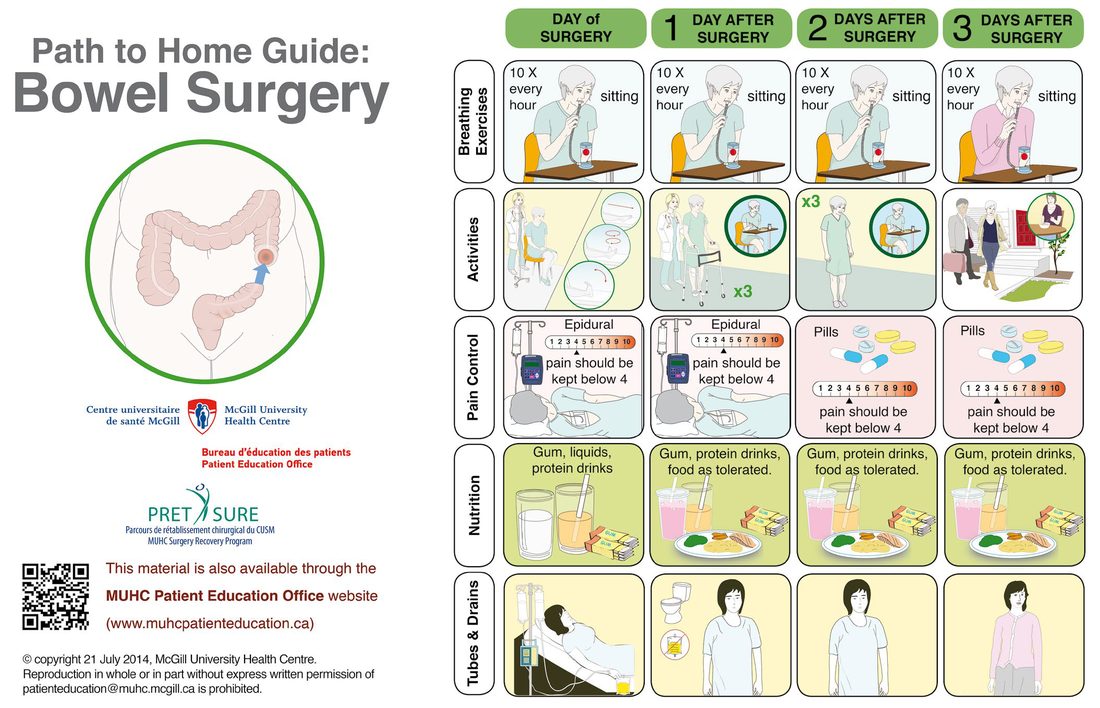
Analgesia in the laparoscopic era
- Epidural analgesia is no longer recommended for laparoscopic surgery, because of the reduction in wound size and tissue trauma [1].
- Patient-controlled analgesia is usually sufficient and avoids the fluid shifts and hypotension seen with epidurals [1].
- Suggested adjuncts are one-shot spinal diamorphine and a 6 to 12 hour infusion of intravenous lidocaine, which are opiate sparing, improve gut function and enhance overall recovery [1].
Bailey & Love summarises the proactive ERAS approach in four items: minimal access techniques; blockade of afferent painful stimuli by epidural, spinal or wound catheters; minimal periods of starvation; and early mobilisation [1].
The ERAS elements in Schwartz's detail
- The preoperative clinic sets expectations (what to do at home, expected stay and disposition, tubes and lines, discharge criteria) making the patient the leader of their own care ("if individuals train for a race, should they not prepare for their procedure?"); since about 90 million Americans struggle to act on health information, material should be at sixth-grade reading level with audiovisual aids [4].
- Nutrition: standard high-protein oral supplements reduce complications and are as good as immunonutrition (arginine, omega-3) in infections, complications and stay; prehabilitation ("enhancing functional capacity to withstand a stressful event") cut ICU stay by a day and hospital stay in 246 low-risk cardiac patients, fitness independently predicts survival after lung resection, interval training three times a week for 6 weeks fits the window after neoadjuvant chemoradiotherapy for rectal cancer, 60-minute sessions 2–4 weeks before major abdominal surgery in the elderly improved mortality, discharge home and stay, and even 1–7 days of therapy reduced complications; smoking raises mortality, prolonged ventilation, pneumonia, DVT, infection and poor healing through carbon monoxide, nicotine vasoconstriction and higher oxygen demand, longer abstinence being better for bronchiolar and collagen remodelling [4].
- Fasting 6–12 hours breeds insulin resistance; European and American guidelines allow clear fluids to 2 hours (except gastroparesis, obstruction, dysphagia) and solids to 6, carbohydrate drinks to 2 hours do not increase aspiration and reduce hunger, thirst, anxiety and nausea, a 2–4 hour fast leaves smaller gastric volume and higher pH than over 4 hours, and the usual hypo-osmolar regimen is 100 g of carbohydrate the evening before and 50 g 2–3 hours before surgery, shortening stay when the expected stay exceeds 2 days [4].
- Intraoperatively: bathing, chlorhexidine or povidone preparation and guideline prophylaxis; minimally invasive approaches; drains and catheters only when necessary because they tether ambulation; hypothermia, inadvertent in up to 90% of elective patients, worst over 60, in malnutrition, diabetes with neuropathy, hypothyroidism, general anaesthesia and long surgery, impairs healing (relative risk 3.25), causes cardiac events (4.49), transfusion (1.33), infection and pressure ulcers, heat leaving by radiation (50–70%), convection (15–25%), evaporation (5–20%) and conduction (3–5%) while anaesthesia lowers the thermoregulatory threshold and relaxants abolish shivering, so patients are prewarmed and warmed with filtered forced air, insulated, given warm irrigation, infusions and blood in warmer theatres; VTE, the leading preventable perioperative death, DVT after about 25% and PE after 7% of unprophylaxed major operations, usually silent, is prevented systematically by early ambulation, stockings, pneumatic compression and low-dose heparin, LMWH or Xa inhibitors by procedure-specific guideline [4].
- Fluids: fixed-volume regimens failed; goal-directed therapy by oesophageal Doppler, bioimpedance or waveform analysers gives fluid only when cardiac output will rise and pressors otherwise, aiming at normovolaemia and zero balance with minimal weight change, hypovolaemia brings hypotension, renal hypoperfusion, endothelial dysfunction and coagulopathy, hypervolaemia splanchnic and pulmonary oedema, dehiscence, immobility, coagulopathy and organ failure, and Doppler-guided trials cut stay by up to 4 days across GI, trauma, urological and orthopaedic surgery; intravenous fluid stops once liquids are tolerated, Doppler is unvalidated in unventilated patients, colloids are no better than crystalloids (Cochrane), and 0.9% saline causes hyperchloraemia with longer stay and higher mortality, an odds ratio of 2.05 for death against Plasma-Lyte in 22,851 patients, with more kidney injury, GI complications, bleeding and infection, so balanced crystalloid is preferred [4].
- Pain is subjective and cannot be experienced while unconscious, so intraoperative tachycardia and hypertension are treated with β-blockers or deeper anaesthesia rather than opioids, whose exposure worsens postoperative pain scores, increases opioid need, nausea, respiratory depression, ileus, urinary retention, endocrine suppression and immunosuppression; multimodal analgesia uses paracetamol, celecoxib or NSAIDs and gabapentin before and after surgery, intraoperative ketamine, lidocaine and magnesium (continued postoperatively), neuraxial opioid or local anaesthetic (better than oral, IV or IM morphine and recommended by the American Pain Society for thoracic, abdominal, caesarean, hip and lower-limb surgery and for those at cardiopulmonary or ileus risk) and regional blocks (peripheral, paravertebral, plexus, infiltration) that spare opioids and avoid epidural retention and hypotension, with opioid PCA as one component rather than the mainstay; NSAIDs risk renal injury, bleeding, delayed healing and cardiovascular events, local anaesthetics cardiac and CNS toxicity, ketamine dysphoria, gabapentinoids visual disturbance [4].
- PONV (vomiting about 30%, nausea 50%, combined up to 80%) follows female sex, prior PONV or motion sickness, non-smoking, youth, general over regional anaesthesia, volatiles and nitrous oxide, opioids, long anaesthesia and cholecystectomy, laparoscopy, gynaecological and strabismus surgery; prevention avoids general anaesthesia, uses total intravenous anaesthesia, no nitrous or volatiles, minimal opioids and adequate hydration, with one agent for low risk and two for medium or high from dexamethasone, 5-HT3 antagonists, antidopaminergics, scopolamine, dimenhydrinate, perphenazine and aprepitant, targeted before it occurs [4].
- Ileus, the commonest cause of prolonged stay and readmission after GI surgery, up to 19%, doubling index-stay cost, follows open surgery, long operations, transfusion, fasting, fluid overload, opioids and PONV; prophylactic nasogastric tubes delay recovery and add pulmonary complications without preventing leaks in gastroduodenal, biliary, trauma or oesophageal surgery and are abandoned, minimally invasive and meticulous low-blood-loss surgery, multimodal analgesia, neuraxial blocks and normovolaemia help, chewing gum (sham feeding via the cephalovagal reflex) has uncertain benefit within ERAS, and alvimopan, a µ-antagonist given before and twice daily after surgery, discharging 0.7 days earlier in phase III pooling, helps open but not laparoscopic surgery [4].
- Mobilisation counters deconditioning, DVT and muscle loss (older patients decline after only 2 days in bed), preoperative exercisers are more active afterwards, and pamphlets, daily task lists, mobility logs and pedometers reinforce expectations though compliance is hard to track when pain or tethers intervene [4].
ERAS by specialty and implementation in Schwartz's account
- Kehlet's 1997 colon series founded the field; the first guidelines came in 2012; Delaney's 1000 consecutive laparoscopic colectomies showed short stay with low readmission and mortality, meta-analyses confirm less opioid use, shorter stay and lower morbidity without more readmissions for open or laparoscopic colon and rectal resection, some units discharge within 24 hours and Gignoux on the same day, octogenarians and patients with diverting stomas benefit (ileostomy slightly delays discharge), adherence is inversely related to stay, carbohydrate loading, no nasogastric tube, early mobilisation and oral nutrition, total intravenous anaesthesia, early catheter removal and non-opioid analgesia predicting the shortest, while pathology, intraoperative complications, blood loss, long surgery, immobility, emesis, persistent intravenous fluids, catheter reinsertion and poor pain control predict deviation, readmissions (mostly obstruction and soft tissue infection) relate to poor compliance and neoadjuvant chemoradiation, and ERAS cuts direct and indirect cost, speeds return to work and eases caregiver burden [4].
- Liver resection: 92% ate on day 1 with stay falling from 8 to 6 days in a first series and from 7 to 4 in a randomised trial with fewer medical complications and better quality of life; pancreaticoduodenectomy (ERAS Society guidelines 2012) halves delayed gastric emptying and benefits the elderly; gastrectomy (2014 guidelines) removes the nasogastric tube in theatre, feeds within a day and supports nutrition when intake is under 60%, with fewer grade III complications; oesophagectomy programmes keep prolonged nasogastric decompression but feed early by jejunostomy and reduce stay, leaks and pulmonary complications; bariatric surgery (2016 guidelines) discharges sleeve and bypass patients on day 1 without more calls, emergency visits or readmissions; large ventral hernia repair with myofascial release cuts stay by up to 2.5 days without early recurrence; radical cystectomy, cytoreductive gynaecological oncology and joint replacement all benefit [4].
- Implementation is cultural: define current and goal states, draft the protocol in a small engaged group, review with every stakeholder (surgeons, anaesthetists, inpatient and outpatient nurses, pharmacists, IT, compliance, administration), build patient and staff education and standardised order sets (live up to two weeks before the protocol), fix a go-live date given to the project manager a month ahead, audit weekly then monthly (length of stay, 30-day readmission, PCA use) with monthly multidisciplinary checkpoint meetings for at least three months, and reinvest part of the savings in the programme [4].
- Traditional Chinese medicine adjuncts: acupuncture-combined anaesthesia halves opioid dose experimentally and lowers postoperative opioid needs at 8, 24 and 72 hours by raising enkephalin, electroacupuncture cuts fentanyl and improves recovery, intraoperative P6 (Neiguan) stimulation prevents PONV as well as standard antiemetics and electroacupuncture matches ondansetron, auricular acupressure within 24 hours works similarly, and acupuncture at Zusanli, Shangjuxu and Xijuxu with early feeding or decoctions such as Dachengqi and Simo shortens ileus and stay against chewing gum, with historical roots in Huang Di Nei Jing, the 659 AD Tang pharmacopoeia (883 years before Nuremberg) and Tu Youyou's 2015 Nobel for artemisinin [4].
Procedural interventions
The day surgery pathway
The pathway runs in eight steps: the patient is listed for a day case procedure from outpatient clinic; nurse-led preoperative assessment, often the same day as clinic; a high-risk anaesthesia clinic if the patient is deemed high risk, and if they are unsuitable for the day surgical unit, exploring inpatient admission, local or regional anaesthesia, or cancellation; the patient is given an operation date with specific preoperative instructions; protocol preoperative checks on the day of admission; the operation in the day surgical unit theatre; discharge with appropriate analgesia and postoperative instructions; and follow-up in clinic or by telephone if required [2].
There is room for innovation in the pathway itself, a recent example being GPs fast-tracking referrals directly to preoperative assessment clinics, eliminating a step [2].
The day surgical unit
Dedicated day wards and self-contained units separate from the main hospital building led to significant improvements in same-day discharge [2]. The model works best with its own dedicated theatre suites and recovery wards, day surgery care-trained nursing staff, and patient facilities such as parking and a waiting area [2].
The most functional units are those ring-fenced against the emergency pressures of the main hospital, and opening times should be at least 7 a.m. to 8 p.m. to maximise the service [2]. Most UK trusts now have such a unit [2].
Every unit requires a Clinical Lead with a subspecialty interest in day surgery, usually an anaesthetist or a surgeon, with protected time in their job plan, responsible for developing local guidelines, pathways and clinical governance within the unit [2].
Ambulatory surgery centres in Schwartz's account
- Ambulatory surgery grew from itinerant dental surgeons, James Nicoll's 1909 report of nearly 9000 Glasgow children operated on as outpatients (cleft, pyloric stenosis, hernias, mastoidectomy) at "a tithe of the cost", Ralph Waters' 1919 office practice in Sioux City using nitrous oxide, morphine and scopolamine with strict medical selection (the prototype free-standing centre), Webb and Graves' 1959 Vancouver outpatient surgery and the first US hospital outpatient department at UCLA in 1962 (Cohen and Dillon), to Reed and Ford's Phoenix SurgiCenter in 1970 (1200 operations by 153 surgeons in 6 months with one admission) which spawned the Ambulatory Surgery Center Association; the 1976 Orkand Report confirmed cost savings at hospital quality, SAMBA formed in 1984, California first mandated accreditation in 1996, and CMS now certifies over 5300 centres and reimburses over 3500 procedures (from 200 in 1982), with more than 23 million procedures a year, ophthalmology 30%, orthopaedics 15%, gastroenterology 14%, pain 10%, plastics 8% and urology 5% [6].
- Centres save $3.8 billion a year ($1.5 billion to patients in deductibles and coinsurance; $32.5–57.6 billion projected over a decade; $7.5 billion for Medicare in 2008–2011) because procedures cost a half to a third of hospital rates, cataract $942 vs $1334, and per-claim savings of $219 for cataract, $110 for gastroscopy with biopsy and $172 for colonoscopy with biopsy, with 31.8 fewer minutes per procedure, cases under 2 hours (average 30–45 minutes), no emergencies to bump elective lists, a single theatre per surgeon, stable teams who stay until the list ends, faster turnover (some surgeons doing three times the volume) and recovery with family; Medicare pays under the Outpatient Prospective Payment System capped at 59% of hospital rates since 2003 [6].
- Oversight is Medicare certification under the Conditions for Coverage, state licensure (37 states require certificate of need) and voluntary or mandated accreditation by AAAHC, AAAASF or the Joint Commission (accredited centres had fewer hospitalisations within 7–30 days of colonoscopy) and quality matches hospitals for antibiotics, falls, wrong-site surgery and checklists; under 2% of visits led to an unplanned hospital visit within 7 days in 2014–2016 (1.6% emergency or observation, 0.6% admission), unplanned admission runs 0.5–2%, predicted by age 65 or over, expected operating time over 120 minutes, cardiac, peripheral vascular and cerebrovascular disease, malignancy, HIV, regional or general anaesthesia and above all prior hospitalisation, with Medicaid, low income and comorbidity predicting acute-care use, and outpatient cholecystectomy is safe with selection at a median $6028 against $10,876 [6].
- Ninety per cent of centres have physician ownership and 25–30% hospital stakes, giving control of scheduling, staff and equipment but a share of facility fees that may lower thresholds, owners perform more procedures than non-owners at the same facility and the rise in centre procedures exceeded twice the hospital decline, and may steer insured patients to their own facility, all regulated by the Stark Law; office-based suites under lighter regulation risk "practice drift" yet accredited suites proved as safe as centres for cosmetic surgery; and the elderly may gain most from same-day discharge through less postoperative cognitive dysfunction, lower cost and comfort at home [6].
Complications
The complications ERAS and day surgery are designed to avoid are those of the perioperative process rather than of the operation: the reduction in gut motility and nausea from opiates, the cardiovascular and gastrointestinal effects of autonomic spinal blockade from epidurals, the fluid shifts and hypotension seen with epidurals, and the fluid and electrolyte imbalance and disrupted gut flora that follow bowel preparation [1][3].
Day surgery reduces hospital-acquired infection simply by shortening exposure [2].
The failure mode of day surgery is the unplanned overnight stay, which is why patient selection, the responsible adult at home for 24 hours, and the suitable home environment are treated as clinical criteria rather than administrative ones [2].
Outcomes
ERAS protocols commonly reduce postoperative length of stay by 30 to 50%, with associated savings in healthcare costs, and ERAS principles are now applied by protocol to many types of major surgery with considerable benefit in outcomes [1].
Day surgery's stated benefits are reduced hospital stay, reduced hospital-acquired infection, reduced healthcare-related costs, improved patient experience and improved service efficiency [2].
Neither works as a document. Successful day surgery is described as dependent on motivated patients, an effective pathway and enthusiastic day surgery staff [2]; ERAS is described as intensive and demanding, and as depending on the combined effect of several interventions rather than any one of them [1][3].
References
- Bailey & Love's Short Practice of Surgery, 28th ed., Ch. 1 Metabolic response to injury
- Oxford Handbook of Clinical Surgery, 5th ed., Ch. 25 Day case surgery
- Oxford Handbook of Clinical Surgery, 5th ed., Ch. 2 Principles of surgery
- Schwartz's Principles of Surgery, 11th ed., Ch. 50, Optimizing Perioperative Care: Enhanced Recovery and Chinese Medicine, Fig. 50-3
- Sabiston Textbook of Surgery, 22nd ed., Ch. 11 Advances and Training Considerations in Laparoscopic Surgery
- Schwartz's Principles of Surgery, 11th ed., Ch. 52, Ambulatory Surgery, Figs. 52-7 and 52-8